To sell a musical instrument in Czechia, photograph it in daylight, price it against three or four comparable listings in your city, write a listing that names the model and its real condition, and meet the buyer in a public place with cash or an instant bank transfer. A classifieds listing reaches local buyers faster than a shop trade-in and usually returns more money, provided you handle the handover carefully.
Czechia has a dense second-hand market for guitars, keyboards, violins, brass and drums. Brno, Prague, Ostrava and Plzen each have their own pool of buyers, and a Fender Stratocaster listed in Prague may sit for weeks while the same guitar in Brno sells in days. Distance matters more than most sellers expect. Buyers rarely cross the country for an instrument under 15,000 CZK, so your listing should name the city and the district from the start. This guide covers the whole path: pricing, photos, the description, answering messages, filtering scams, the handover, and what Czech law says about a private sale. Small shops and music schools selling off stock follow the same steps, with one difference noted later.
How to price a used instrument against real listings
Price comes from comparable listings, not from what you paid. Open the marketplace, search your exact model, and note what sellers are asking in your region. Asking prices are not sale prices, so treat them as a ceiling rather than a target.
What to look at before you set a number
Four things move the price of a used instrument in Czechia: brand and model, condition, accessories, and how long the seller has been waiting. A guitar with a hard case and a recent setup sells for more than the same guitar alone. Original parts matter to collectors. A repaired headstock crack cuts the value noticeably, and hiding it costs you the sale later.
As a rough starting point, most mass-produced instruments from the last fifteen years lose value quickly and then flatten out. Entry-level keyboards and student violins often settle between a third and a half of the new price. Mid-range and professional instruments hold better. Limited editions and discontinued models can hold or rise, but only when a buyer in Czechia is looking for that model.
Check the current retail price of the same instrument new in Czech shops. If your used price sits within ten percent of a new one with a warranty, buyers will choose the new one. That gap is your real constraint.
How to photograph and describe a musical instrument listing
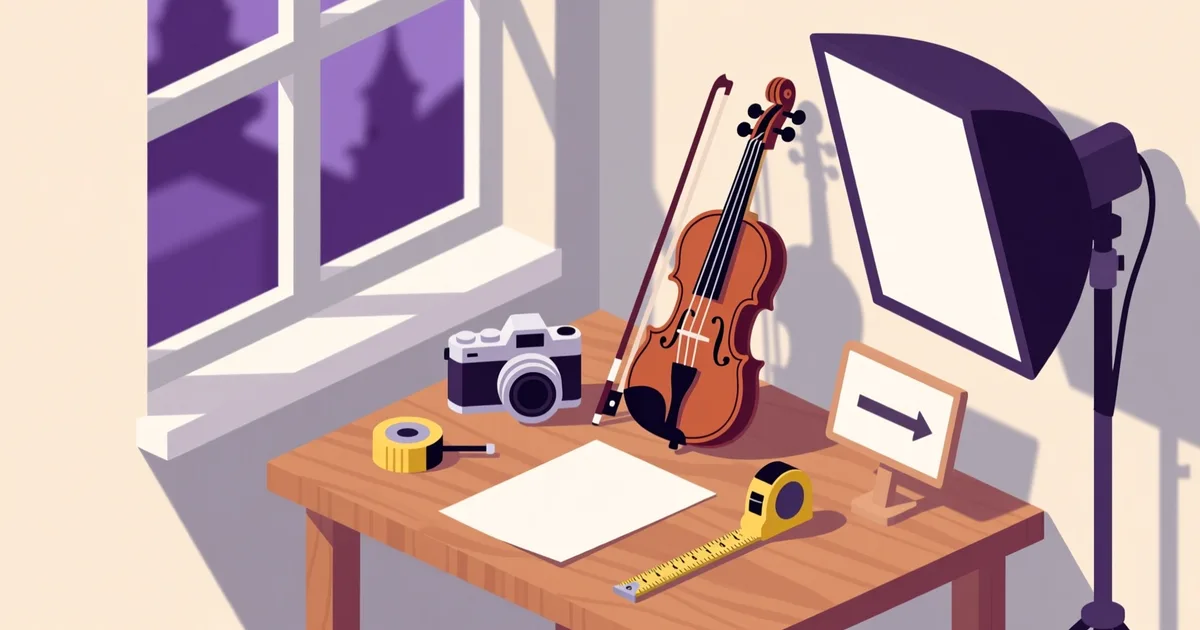
A listing gets messages when the photos answer the buyer's first three questions: what is it, what condition is it in, and what comes with it. Blurry phone shots in a dark room kill interest before the price is even read.
Photos that work
Shoot in daylight near a window, on a plain background. Take a full front shot, a full back shot, and close-ups of the headstock, the fretboard, the bridge, and any scratch or dent. Photograph the serial number and the label inside an acoustic instrument. If you have the case, the cable, the stand or the original box, put them in one photo together. Eight to twelve photos is normal for an instrument above 5,000 CZK.
Description that answers questions
Write the brand, model and year in the first line. Then state the condition honestly: what is worn, what was replaced, what was repaired and when. List the accessories included. Name the city and district. Add the reason for selling if it is simple, since buyers read that as a sign of a real seller.
Include the serial number in the text as well as the photo. It lets a serious buyer verify the year and the factory. If the instrument has been serviced, name the workshop and the year. Do not describe an instrument as perfect if the frets are worn. Buyers inspect on pickup, and a surprise ends the deal.
For pricing comparisons across categories, the same listing logic applies whether you are moving a guitar or clearing out a household, and post a listing covers how the category filters work.
How to answer buyers and filter scammers
Most scam attempts follow two scripts: a fake payment confirmation and a courier who needs a prepayment. Both rely on you sending the instrument or money before anything is verified.
The fake payment screenshot
A buyer sends an image of a bank transfer that never arrives. The screenshot looks correct because it was edited. The rule is simple: money is real when it appears in your account or in your hand, not when a photo of it appears in a chat. If someone pressures you to ship because "the transfer is already sent", stop replying.
The courier prepayment
Another common pattern: the buyer says a courier will collect the instrument and asks you to pay a fee, a customs deposit or an insurance charge, promising to reimburse you. There is no courier. Any deal where you pay money to receive money is a scam.
Smaller warning signs
Refusal to meet in person, a price agreed instantly without a single question about condition, a request to move the conversation to a different channel within the first message, and pressure to decide today. A real buyer of a 20,000 CZK instrument asks about the neck, the setup or the year.
Before you publish, ask yourself one question: if the buyer arrived tonight with cash, could you complete the handover without needing anything else? If the answer is no, the listing is not ready.
We see the same patterns in messages across our categories: buyers ask about the year, the setup and whether the case is included, and the listings that answer all three in the text get replies first.
Keep the conversation inside the marketplace while you are still deciding. EX & GO shows a seller's history and reviews, which helps you judge who you are talking to, and its posting rules are set out at /en/rules. If a listing breaks those rules, report it rather than arguing with the seller.
Where to meet and how to hand over an instrument
Meet in daylight, in a place with people and cameras: a shopping centre entrance, a metro station hall, a music shop, a cafe. For anything above roughly 30,000 CZK, a bank branch lobby is a reasonable choice, and some buyers will agree to complete the transfer there.
Steps for a safe handover
- Agree the price and the meeting point in writing in the chat before you leave.
- Bring the instrument in its case and bring every accessory you listed.
- Let the buyer test it. Ten minutes of playing prevents almost every later complaint.
- Take payment in cash or by an instant transfer you can see land in your banking app.
- Do not hand over the instrument before the payment is confirmed on your side.
- Write a short receipt with the date, the model, the serial number and the amount, and both of you sign it.
- Keep the chat history until the deal is fully closed.
A receipt is not required for a private sale, but it settles any later disagreement about what was sold and for how much. For a business sale it matters more, since the buyer may need it for accounting.
What applies to private sales in Czechia
A private sale between two individuals is not the same as buying from a shop. The seller does not carry the statutory two-year liability that a business owes a consumer. That protection applies when a business sells to a consumer, which is why the distinction matters for both sides.
You still cannot misrepresent what you are selling. If you describe an instrument as fully functional and it is not, the buyer can raise a claim. The practical defence is a description that states the real condition and a handover where the buyer tested the instrument. The Czech Trade Inspection Authority handles consumer protection questions and publishes guidance on rights in sales at coi.cz.
If you sell regularly rather than once, you may be treated as a business, and that brings obligations around receipts, taxes and consumer rights. The Ministry of Industry and Trade publishes the framework at mdcr.cz. If you are clearing a shop, a school or a collection, check your position before you list twenty instruments in a month.
Data protection applies to you as a seller too. Do not publish your full address, your ID number or your bank details in a public listing. Share the meeting point and the payment details only with the buyer you have decided to meet.
Quick sale, best price, or trade-in: which route to take
There is no single best route. The right one depends on how fast you need the money and how much effort you are willing to put in.
- Quick sale through a classifieds listing at a price ten to twenty percent below comparable listings. You get messages within days, and you accept less money. Best when you are moving, or when the instrument is bulky.
- Best price through a classifieds listing at market level, with strong photos and full detail. Expect two to six weeks for mid-range instruments and longer for niche models.
- Trade-in at a music shop. Fastest and simplest, and the shop handles the buyer. The offer is usually well below private sale value because the shop carries the resale risk. Reasonable for a beginner instrument you want gone this week.
- Consignment at a shop. The shop displays and sells it for a commission. You get more than trade-in and less than a private sale, with no messages to answer.
- Sale to a music school or a teacher. Works for student instruments and for anything in steady local demand. Payment is often slower, but the buyer knows what they are getting.
For most private sellers in Czechia, route two returns the most money and route one returns it fastest. Compare the effort honestly before you choose.
Checklist before you publish a musical instrument listing
- Model, year and serial number written down correctly.
- Eight to twelve photos in daylight, including every flaw.
- Price checked against at least three comparable listings in your region.
- Condition described honestly, including repairs and replacements.
- Accessories listed, and all of them ready to hand over.
- City and district named in the listing.
- Payment methods decided in advance.
- Meeting place chosen, in daylight, with people around.
- No personal data beyond what the deal requires.
- Chat history kept until the sale is complete.
Work through the list once, publish, and expect the first messages within a few days if the price is realistic. If nothing arrives in a week, the price is the problem, not the photos. For questions about listings, moderation or your account, the support pages at /en/support cover the process. When you are ready to compare prices in your own city, used musical instruments shows what other sellers are asking right now.
Frequently asked questions about selling a musical instrument in Czechia
How long does it take to sell a musical instrument in Czechia?
A realistically priced instrument in Prague or Brno usually gets its first serious messages within three to seven days. Mid-range guitars, keyboards and brass sell in two to four weeks. Niche models, unusual tunings and professional orchestral instruments can take two months or more, because the buyer pool is small and often national rather than local. If a month passes with no messages, lower the price rather than reposting.
Do I need a contract to sell a musical instrument privately in Czechia?
No contract is required for a private sale between two individuals. A short receipt with the date, the model, the serial number and the price is enough to prevent later disagreement. If you sell as a business, the buyer may need a proper receipt for accounting, and consumer protection rules apply to that transaction.
How do I avoid fake payment screenshots when selling an instrument?
Treat a payment as real only when it shows in your own banking app or in your hand. Never ship or hand over an instrument because someone sent a screenshot. If the buyer insists the transfer is already sent, ask them to wait until it appears on your side. A genuine buyer will wait. Someone pushing you to act on a photo is not a buyer.
Should I accept a courier arranged by the buyer?
Be careful. A common scam involves a buyer who arranges a courier and asks you to pay a fee, deposit or insurance charge first. No legitimate buyer asks the seller to send money to receive money. If you cannot meet in person, agree on a payment method where the funds are confirmed in your account before the instrument leaves your hands.
Where is the safest place to hand over an instrument in Czechia?
Choose a public place in daylight with people and cameras: a shopping centre entrance, a metro station hall, a music shop or a busy cafe. For expensive instruments, a bank branch lobby works well, since you can confirm the transfer on the spot. Avoid flats, garages and quiet side streets, especially for evening meetings.
Does the buyer have warranty rights on a private sale in Czechia?
Statutory consumer warranty applies when a business sells to a consumer, not between two private individuals. A private seller still cannot misrepresent the item. If you described an instrument as fully functional and it is not, the buyer can raise a claim. Honest condition notes and a test at handover are the practical protection for both sides.