Buying second-hand tools is most efficient if you start with a clear checklist, compare the price with the market, and close the deal only after you see the tool working. In Romania, most listings come from private individuals in Bucharest, Cluj-Napoca, Timișoara, Iași, and Constanța, and the difference between a good deal and a loss of money lies in the details you ask for before meeting the seller.
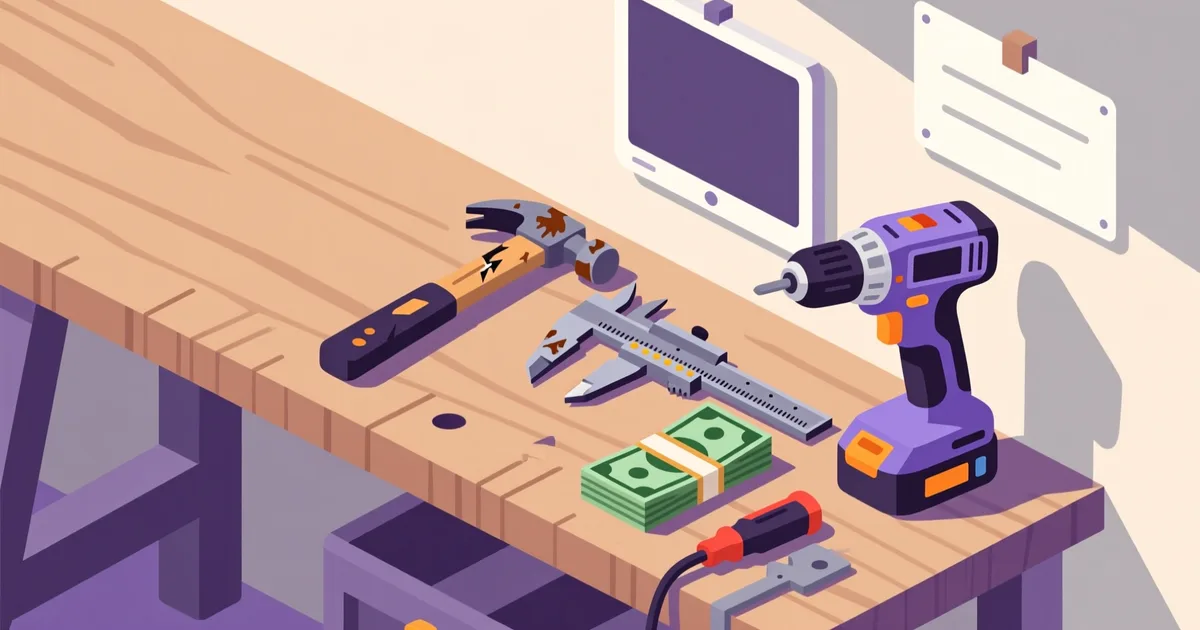
A new professional drill costs several hundred lei, and a brand-name second-hand angle grinder can be had for half the price if you know where to look and what to ask. The problem is not the offer, but the screening. Many listings use photos from the internet, ask for an advance payment by bank transfer, or promise courier delivery without inspection. All of these are signals you can recognize in two minutes if you know what to look for.
This guide covers the complete path: where real listings appear, how to read a listing, what to check at the meeting, how to negotiate, and what rights you have as a buyer in Romania. It includes a checklist you can open on your phone right in front of the seller and a table comparing the three main sources of purchase.
- Check the seller's identity and account history before you discuss the price.
- Refuse advance payment by bank transfer for a product you haven't seen working.
- Test the tool on the spot: start-up, noise, vibrations, included accessories.
- Ask for the invoice or receipt if available, for warranty and proof of origin.
Where to find second-hand tools in Romania
Listings for second-hand tools appear in three main places: flea markets and local fairs, social media sales groups, and classified ad platforms. Each has a different seller profile and a different level of risk.
In Bucharest, the Vitan area and the Valea Cascadelor fair remain spots where you find tools from craftsmen liquidating their workshop. In Cluj-Napoca, Piața Flora and the Mărăști areas gather occasional sellers. Timișoara has fairs in the Iosefin area, while Iași and Constanța have similar markets, with lower traffic but sometimes better prices, because local demand is weaker.
What a classified ad platform offers
Classified platforms gather offers from all over the country and allow filtering by city, search radius, and category. You can see dozens of listings for the same tool and compare the asking price in several cities before contacting anyone.
A real advantage is the seller's history. On EX & GO you see how many listings the person has published, in which city, and what reviews they have received from previous buyers. Moderation removes listings that break the posting rules, and phone numbers are verified before an ad goes live. second-hand tools
Messages are sent directly on the platform, without exposing your phone number from the start. Payment does not go through the site: you meet the seller, check the tool, and decide then. The complete rules for posting and running listings are described in the platform rules.
What to check in a listing before you call
A serious listing contains real photos of the tool you will receive, not catalog images. The first check is simple: do a reverse image search. If the photo appears on the manufacturer's website or on dozens of other listings, it is a clear signal.
Red flags in a listing
Asking for an advance payment by bank transfer for a tool that hasn't been seen remains the most common scam mechanism. The seller claims to have several interested buyers and asks for a small amount, usually 50 or 100 lei, as a reservation. After the transfer, they disappear.
The second pattern is the courier. You are told the product is sent through a delivery company, with payment on delivery, but the tracking link leads to a fake site that asks for card details. No serious courier company asks for payment through a link sent on WhatsApp.
The third signal is a price far below market. A Bosch or Makita angle grinder at 80 lei, when the average is 250 to 400, is not a deal, it is a trap. The correct price is established by comparing five or six similar listings in the same city.
The most useful thing you can do before the meeting is to ask for a photo of the tool's identification plate, where the exact model and serial number are visible. A seller who avoids this request has a reason, and you save a trip.
Checklist for the meeting
At the meeting, the order of checks matters less than the fact that you do them all. Open the list on your phone and go through it point by point, without rushing out of politeness.
| What you check | How you check | Why it matters |
|---|---|---|
| Start-up and noise | Start the tool, listen to the motor at full speed | A worn bearing is heard immediately |
| Vibrations and play | Grab the chuck and move it sideways | Play indicates wear on the shaft |
| Cable and plug | Check the insulation along the entire length | A cracked cable is a risk of electric shock |
| Accessories | Count the discs, drill bits, wrenches, case | Missing accessories cost separately |
| Identification plate | Compare the model with the one in the listing | Confirms it is exactly the promised product |
| Documents | Ask for the invoice, receipt, or warranty certificate | Proof of origin and purchase |
If the tool is battery-powered, ask to see the charger and test the battery. A lithium-ion battery that doesn't hold a charge is the most expensive hidden defect, because replacing it can cost as much as half the tool's price.
For power tools, ask when it was last used and in what conditions. A grinder that cut concrete daily has different wear than one used a few times a year in a garage. second-hand tools in Bucharest
How to negotiate the price for second-hand tools
Negotiation starts with information, not with the offer. Before you talk to the seller, note the prices of three or four similar listings in the same city and in nearby cities. This way, your offer has a concrete basis.
The most effective approach is to list the real defects you have noticed and propose a price that reflects the cost of fixing them. If a cutting disc is missing and costs 40 lei, and the cable needs replacing, subtract these amounts from the asking price and explain why.
Private sellers usually accept a 10 to 20 percent discount, especially if you pay on the spot, in cash, and take the product the same day. Larger discounts appear at workshop liquidations, when someone gets rid of dozens of tools at once and wants to finish quickly.
What rights you have as a buyer in Romania
A transaction between two private individuals is not covered by the legal warranty for consumers, because the seller is not acting as a professional. If the tool breaks after two days, you have no simple way to ask for your money back. That is why checking on the spot is essential.
The situation changes when you buy from a second-hand shop or from a service center that also sells tools. Then you are a consumer, and your rights are protected. The National Authority for Consumer Protection explains on its website ANPC what you can do in case of a problem. For verifying the origin of a tool that bears an identification number, the Romanian Auto Registry has no jurisdiction, but DRPCIV remains the reference source for vehicle documents, useful if the purchase includes a trailer or a machine with a registration number.
Private individual, shop, or platform with seller history?
Each option has a different balance between price, risk, and effort. There is no universal choice, but there is one suitable for your specific situation.
| Criterion | Private individual | Second-hand shop | Platform with seller history |
|---|---|---|---|
| Price | Lowest, negotiable | Higher, with commercial markup | Variable, quickly comparable |
| Warranty | None | Possible, offered by the shop | None, but there are reviews |
| Pre-check | Only on the spot | Possible in the shop | Photos, history, messages on the platform |
| Fraud risk | High with advance payment | Low | Reduced by moderation and phone verification |
| Effort | High, multiple trips | Low | Medium, you filter and compare online |
If you need the tool today and want safety, the shop is the practical choice. If you have time and are after a specific model, the platform with seller history gives you the best price-to-risk ratio. The private individual remains the cheapest route, provided you follow the checklist.
We see in the EX & GO catalog that the most sought-after second-hand tools are angle grinders, hammer drills, and welding machines, and the most frequent buyer questions refer to battery condition and the existence of an invoice.
If a problem arises related to a listing, a seller who doesn't respond, or behavior that breaks the rules, you can write to the team through the support center. Moderation does not resolve a commercial dispute, but it can remove listings that break the posting rules.
Frequently asked questions about second-hand tools
How much do second-hand tools cost in Romania?
The price depends on the type of tool and its condition. A brand-name angle grinder usually sells for 200 to 400 lei, a hammer drill for 150 to 350 lei, and an inverter welding machine for 300 to 700 lei. Professional tools from brands used in workshops sell for 50 to 70 percent of the new price. Compare at least five similar listings in your city before setting a reference amount.
Where can I find the cheapest second-hand tools?
The lowest prices appear at workshop liquidations and flea markets, because the seller wants to clear the whole stock quickly. In Bucharest, the Vitan area, and in Cluj-Napoca, Timișoara, Iași, and Constanța, local markets gather such offers. Online, filter listings by city and search radius, then sort by price. Be careful though: the lowest price without an in-person check is the most expensive risk.
How do I recognize a fake second-hand tool listing?
Three signals appear most often. The photos are taken from the manufacturer's website or from other listings, verifiable with a reverse image search. The seller asks for an advance payment by bank transfer before the meeting, usually 50 or 100 lei. Or they propose courier delivery with a payment link sent via messaging. None of these situations is normal for a transaction between people who can meet. Always ask for a photo of the tool's identification plate.
What should I check at the meeting before paying?
Start the tool and listen to the motor at full speed. Grab the chuck and move it sideways to feel for play. Check the cable insulation along its entire length and the condition of the plug. Count the included accessories: discs, drill bits, wrenches, case. Compare the model on the identification plate with the one in the listing. Ask for the invoice or receipt, if available. If the tool runs on a battery, test the battery and ask to see the charger.
Do I have a warranty if I buy from a private individual?
No, generally not. A sale between two private individuals is not covered by the legal warranty for consumers, because the seller is not acting as a professional. If the tool breaks after purchase, you have no simple way to get your money back. The situation changes when you buy from a shop or a service center that sells tools, because then you are a consumer and benefit from the protection offered by consumer protection legislation.
How do I negotiate the price without losing the deal?
Come with information, not a random offer. Note the prices of three or four similar listings and list the concrete defects you have noticed. Propose an amount that deducts the cost of fixing them and explain why. A 10 to 20 percent discount is realistic, especially if you pay on the spot, in cash, and take the product the same day. Stay polite and be prepared to walk away if the price does not come close to the real value.
What to do next
You buy second-hand tools wisely if you treat every listing as a verification, not as a sure deal. Set the desired model, compare prices in your city, ask for real photos and the identification plate, then go to the meeting with the checklist open on your phone. Don't pay anything in advance and don't accept courier delivery with a payment link.
For expensive tools, a one-hour drive to another city can pay for itself if the price difference is a few hundred lei. For small tools, under 150 lei, buy from your city and check on the spot, without complications. Note what you paid and what condition the tool was in, so you have a reference point next time.
If you keep this discipline, you buy second-hand tools at fair prices and avoid the losses that come from rushing. Compare offers, check the seller, test the product, and close the deal only when you are satisfied with what you have seen.