Buying second-hand toys works best when you start with a short checklist, not the price. In Romania, most ads for used toys appear on classified platforms, in neighborhood groups and at flea markets, and the difference between a good deal and a waste of money comes down to three things: the toy's actual condition, the seller and how you complete the payment.
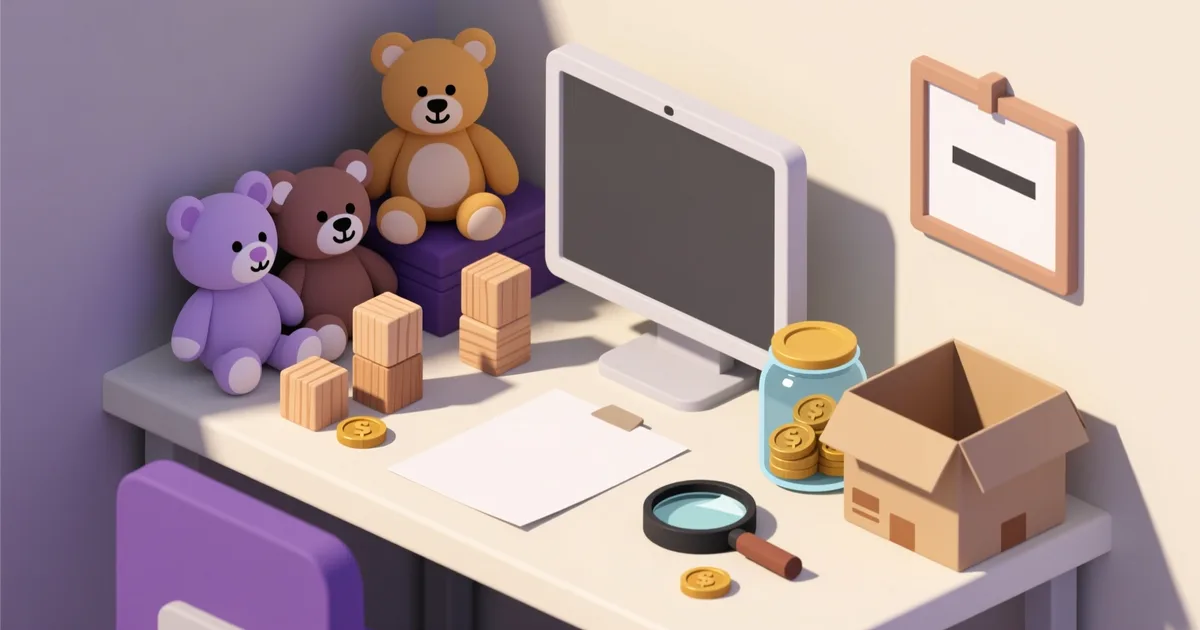
A complete Lego set, a kid's bike or a doll carriage usually sells for 30 to 60 percent of the store price if it's in good condition. The difference shows in the details: missing pieces, leaked batteries, jammed mechanisms, chipped paint. Almost no one tells you this in the ad, so the questions you ask before the meeting matter more than the photos.
This guide covers the full journey: where to look, how to read an ad, what to check on site, how to negotiate and what rights you have as a buyer in Romania. There are five big cities you'll run into most often in ads (Bucharest, Cluj-Napoca, Timișoara, Iași, Constanța), but the principles are the same in smaller towns, where the market mainly moves through local groups.
- Check the seller first: history, reviews, account age. A new account with a price far below market calls for caution.
- Ask for real photos, with the toy in hand or on the floor, not catalog photos. Ask for a short video for toys with mechanisms.
- Don't pay in advance by transfer or card to people you haven't met. Pay on delivery or in person at the meeting.
- At the meeting, test the toy before handing over the money. If it can't be tested, negotiate the price down.
Where to find second-hand toys in Romania
The used toy market splits into three distinct areas, each with a different type of seller and level of risk. The first is online classifieds, where ads sit under categories and cities. The second is neighborhood and parent groups, where sales happen on trust and recommendation. The third is flea markets and second-hand bazaars, good for parts and simple toys, weak for electronics.
On a classified platform with filtering by city and category, you go straight to the kids' products section. Filter by Bucharest, Cluj-Napoca, Timișoara, Iași or Constanța, then narrow the radius to a few kilometers from your neighborhood. That way you avoid long trips for a 40-lei item. On EX & GO you can compare prices between ads and see the seller's history before you write, and the posting rules are spelled out at /ro/rules.
Local groups have a different dynamic. There, prices are often lower because people want to get rid of things quickly, but there's no seller history and no reviews. Practical advice: if you don't know the person, treat the group as a shop window, not a guarantee.
What matters when choosing the channel
A second-hand toy store, where one exists, offers a checked product and sometimes returns. A private seller offers the lowest price, but no warranty. A platform with seller history sits in the middle: private-person price, plus context about who's selling.
Cheap second-hand toys without compromises
The best bargains appear on heavy toys that are hard to ship: kids' kitchens, garages, train sets, swings. The seller wants to get rid of them, and you pay for transport. If you have a car and patience, this is where you save the most.
How to read an ad and spot a scam

A fair ad has photos from several angles, the displayed price, the neighborhood or approximate area and a description that says what's missing. A suspicious ad has photos from foreign sites, a price far below the rest of the market and insistence on advance payment.
The warning signs are fairly consistent. A request for an advance by bank transfer or card to an individual, for a toy you haven't seen. Stories about stuck parcels, couriers asking extra fees, "reserving" the product until payment. Identical photos appearing in several ads, in different cities. A recently created account, with no reviews, selling several expensive toys at once.
The best anti-scam filter is the question "can I see the toy today or tomorrow, at your place in the neighborhood?". A real seller answers with a time and an address. A scammer dodges the question and goes back to payment.
If the seller insists on courier and refuses a meeting, ask for cash on delivery, with inspection before payment. Many couriers in Romania allow opening the parcel. If that's not accepted either, walk away. There are plenty of ads.
Check the seller's history
On platforms that show reviews and account age, read them before writing. A seller with ten positive reviews and an account a year old is a different conversation from one created last week. We see in our catalog that most buyer questions are about the toy's actual condition and missing pieces, not the price.
Checklist for meeting the seller
Take the checklist below on your phone and go through it on site, in order. Don't skip testing just because the seller seems serious. Most problems show up in the first two minutes, if you know where to look.
| What you check | How you check | Why it matters |
|---|---|---|
| Complete pieces | Count the components against the box photo or the ad's list | A missing piece in a building set can make the toy unusable |
| Mechanisms | Start the toy, press the buttons, turn the wheels | Leaked batteries and jammed motors are felt immediately |
| Safety | Look for sharp edges, chipped paint, loose screws | Old paint on wooden or metal toys is a risk for small children |
| Cleanliness | Check hard-to-reach areas, corners, joints | Mold and old dust are hard to remove from textile material |
| Accessories | Ask about the charger, remote, instructions | A missing charger for an electronic toy costs almost as much as the toy |
Testing on site also gives you negotiation arguments. If the mechanism runs hard or two pieces are missing, say so calmly and propose a lower price. It's not a scene, it's a normal discussion about what you're buying.
How to complete the transaction and what rights you have in Romania
Payment is made at the meeting, in cash or by transfer done on the spot, after you've tested the toy. Don't send money in advance. Ask, if possible, for a written confirmation in the platform conversation, with the product description and price. It helps if misunderstandings arise.
Here's a distinction many buyers confuse. Between two private individuals there's no right of return for a simple change of mind, and commercial warranty doesn't apply. Consumer protection applies when you buy from a professional, meaning a store or a seller acting as part of a commercial activity. Your rules and rights are explained by ANPC, and for product and safety matters you can also check DRPCIV.
If the seller is a private individual and the toy turned out defective on first use, the practical solution isn't a formal complaint but a direct discussion. Many sellers accept a refund if the problem is obvious and you have proof of the conversation. If the seller is a company, ask for an invoice and apply the legal warranty rules.
Where to resolve a complaint
On a classified platform, you report the ad or the conversation to the support team. On EX & GO, the help page is at /ro/support, and if the seller broke the posting rules, the ad can be taken down. The platform doesn't hold the money and doesn't handle payment, so the transaction is completed directly between you.
Private seller, store or platform with history?
Choosing the channel changes the price, the risk and the time lost. The table below puts the three options side by side, so you can quickly see what you gain and what you lose.
| Criterion | Private seller | Second-hand store | Platform with seller history |
|---|---|---|---|
| Price | Lowest | Higher, with commercial markup | Close to private-person price |
| Warranty | None | Possible, depending on the store | None, but you see reviews and history |
| Inspection before payment | Yes, at the meeting | Yes, in the store | Yes, at the meeting or on delivery |
| Scam risk | Medium, no context | Low | Low to medium, reduced by reviews |
| Time lost | Variable, depends on the trip | Low | Low, you filter by city and radius |
For expensive toys, such as an electric swing or a large building set, it's worth looking on a platform where you see who's selling. For toys at 20 or 30 lei, the neighborhood group is enough. second-hand toys
How to negotiate the price without ruining the conversation
Negotiation on second-hand toys starts from the actual condition, not the store price. The seller knows they have no warranty to offer, so the arguments that work are concrete: a missing piece, a mechanism that runs hard, a charger you'll need to buy separately.
A 10 to 20 percent discount is normal if you've found a real defect and show it. Requests like "I'll give you half" with no reason, especially for an already cheap toy, shut down the conversation. If the seller has several toys in the same category, you can ask for a bundle price. That's where you save the most, because the seller gets rid of everything at once.
A practical trick: set your maximum price before leaving home and don't go over it on the way. The emotion in front of the toy, especially with the child behind you, costs dearly. second-hand toys in Bucharest
When to walk away
You walk away when the seller doesn't accept testing, when they insist on advance payment or when the price is close to the store price. A new toy, with warranty, at a 15 percent difference, is the rational choice. Second-hand makes sense for big differences and for products that rarely break.
Frequently asked questions about second-hand toys
How much do second-hand toys cost in Romania?
It depends on the category. Small plastic or plush toys usually sell for 10 to 50 lei. Complete building sets reach 100 to 300 lei, depending on size. Kids' bikes, swings and doll carriages in good condition sell for 30 to 60 percent of the store price. The final price depends on condition, missing pieces and how quickly the seller wants to get rid of the item.
Where can I find the cheapest second-hand toys?
The lowest prices appear in local neighborhood groups and at flea markets, especially for bulky toys the seller cannot ship. On classified platforms, filter by city and radius, then sort by price. Compare several ads before writing to the seller so you know the normal price for that toy.
What should I check on a second-hand toy before buying?
Count the pieces against the ad's list, start the mechanisms, press the buttons, check for sharp edges and chipped paint. Look at hard-to-reach areas, joints and textile parts, where old dust and mold are hard to remove. Ask about the charger, remote and instructions. Test the toy on the spot, before you pay, not after.
How do I avoid a scam when buying second-hand toys?
Don't pay in advance to people you haven't met. Ask for real photos with the toy in hand, not catalog photos, and a short video for toys with mechanisms. Check the seller's history and reviews. If they insist on courier and refuse a meeting, ask for cash on delivery with inspection. If that's not accepted either, walk away. There are plenty of ads.
Do I have a right of return if the toy is defective?
Between private individuals, there is no right of return for a simple change of mind, and commercial warranty does not apply. Consumer protection applies when you buy from a professional. If the seller is a company, ask for an invoice and apply the legal warranty rules. If it's a private person, the practical solution is a direct discussion, keeping proof of the conversation.
How do I negotiate the price of a second-hand toy?
Start from the toy's actual condition, not the store price. Point out concretely what you found: a missing piece, a mechanism that runs hard, a charger you'll need to buy separately. A 10 to 20 percent discount is reasonable when the defect is real. For multiple toys from the same seller, ask for a bundle price, which usually works out better.
What to do before your next purchase
You buy second-hand toys wisely when you treat every ad as a check, not a once-in-a-lifetime opportunity. Write to the seller, ask three concrete questions about pieces, mechanism and accessories, request an extra photo. If the answers come quickly and clearly, go to the meeting with the checklist on your phone. If there's hesitation, move on to the next ad.
For more expensive toys, look on a platform where you see the seller's history and can compare prices between ads. For the rest, the neighborhood group remains the fastest. Set a budget, a maximum price and a search radius, and buying becomes a simple check, not a lottery. That way you avoid unnecessary trips and money spent on toys that sit unused.